Your Flinch is Already a Weapon
Every new adult who walks into our school does the same thing on day one. They get tight.
Shoulders up. Jaw set. Fists clenched before anyone has told them to make a fist. Every muscle in the body switched on at once, because somewhere along the way we all learned that tension is what strength looks like. If I'm tight, I'm strong. If I'm strong, I'm safe.
I get it. I did it too. At forty, standing on a mat for the first time, I was the tightest guy in the room, and I was surrounded by younger people who could move circles around me while looking like they were barely trying.
That was the first lesson, and I didn't understand it for a while: they weren't barely trying. They were relaxed.
Tight is slow
Here's the thing nobody tells you before you start. Speed comes from relaxation. A tight muscle has to let go before it can move, so a body that's clenched everywhere is a body that has to unclench everywhere before it can do anything. That's a delay. In a street fight, a delay is the whole fight.
Power works the same way, just in reverse. You don't hit hard by being tight the whole time. You hit hard by being loose right up until the moment of impact, and then tightening everything at once. Relaxed, relaxed, relaxed, hard. Tense and untense. Bruce Lee said be water, and he wasn't being poetic. Water moves fast because nothing in it is holding on.
So the first week, I spend a lot of time telling grown adults to drop their shoulders. "Relax, let go." There's more to it than that, of course. Real power comes from the hips, and learning to rotate them is a whole subject of its own that I'll write about separately. But relaxation comes first, because everything else is built on it. Including the thing I actually want to talk about.
You already have a self-defense system
Nobody taught you this one. Something flies at your face and your hands come up, automatically. Your head pulls back. Your eyes close. It happens before you decide anything, faster than any technique you'll ever learn, and it works. That's the flinch response (some call it the startle flinch or the startle reflex), and it's been protecting your face since before you could walk. Literally, it's ingrained into human DNA, it will bypass your thinking because it's built into you.
Most self-defense training treats the flinch as a problem, something to train out of you so the "real" technique can take over. I think that's backwards. The flinch isn't the problem. The problem is what most people do with it.
Watch an untrained person get swung at. The hands come up, sure, but the rest of the body recoils. They pull inward, ball up, give ground, close their eyes and wait for it to be over. The flinch does its job, and then the body surrenders.
That's the part I want to change.
Become proactive about your flinch response
I tell every new student the same thing: don't recoil into yourself. Push into it instead.
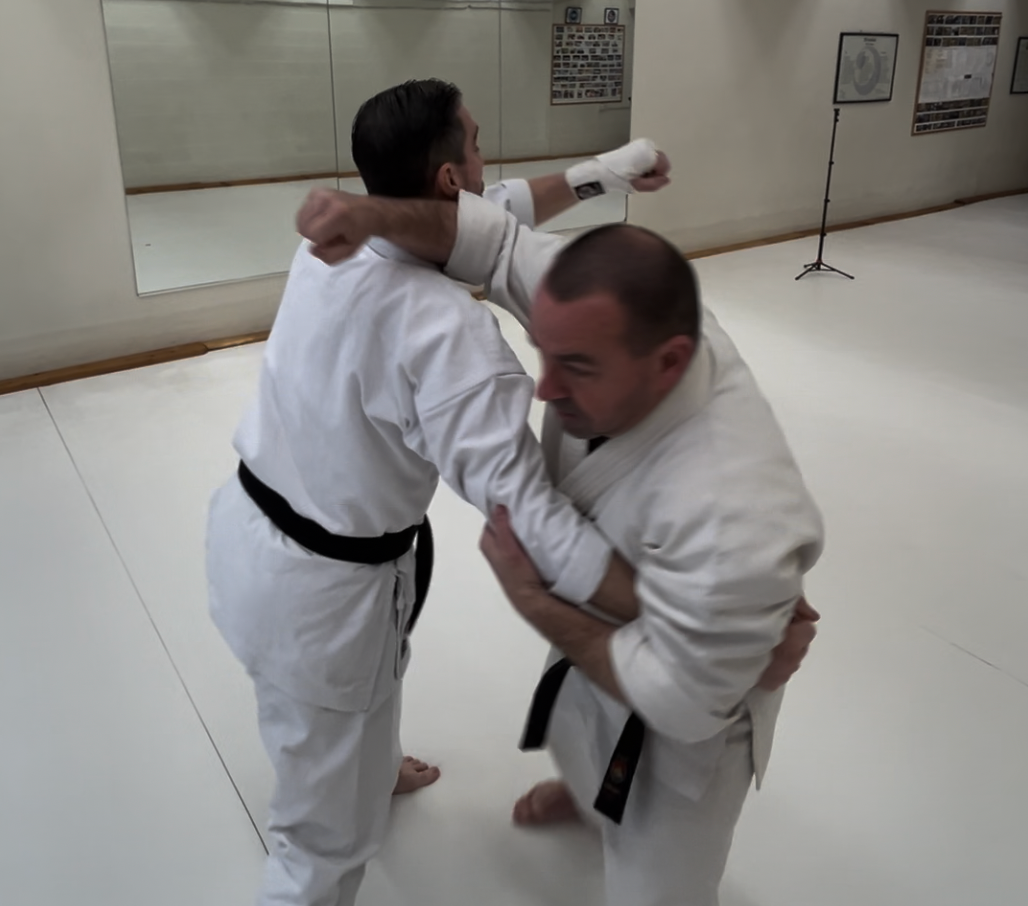
When something comes at you, let the hands come up, because they're going to anyway. But instead of pulling away, drive forward a bit and meet the force. Bend your knees and drop your weight a little as you do it, so you're braced instead of tipping backward. Now your flinch isn't a retreat. It's a block, and it's a block that happens at the speed of reflex, faster than anything you could consciously decide to do.
Then the important part. The instant you feel the contact, their arm on your arms, the grab landing on your guard, and you realize you haven't been hit, you strike. Immediately. Not after you assess. Not after you reset. The flinch and the strike become one motion, and the gap between them gets smaller every time you train it.
That's Te Before Jitsu in one drill. Strike first. Create the pain response. Then worry about controlling the body. Your own nervous system was already doing the first half. We're just teaching it to finish.
And notice why the relaxation lesson had to come first. A tight body can't do this. It flinches and locks. A relaxed body flinches, meets, drops, and fires, because there was nothing holding on.
You have to train it
None of this happens from reading about it. A flinch that hits back is a trained flinch, and the training has to look like the thing you're training for.
In class, we don't drill it against a perfectly chambered oi-tsuki. A textbook lunge punch is beautiful but nobody on the street is going to throw one at you. We drill against haymakers, because that's what an angry person throws. Cross punches. Two-handed grabs at the shirt or the throat. Attacks that are messy, fast, and street-worthy, because your flinch has to learn to recognize the real thing, not the karate version of the real thing.
At first, students flinch and freeze. Then they flinch and block. Then, one day, they flinch and hit, and they look surprised, because they didn't decide to. That's the day the training took.
That's why it's the first thing. Not because it's easy, and not because it's flashy. Because it's the first thing that will ever actually save you, and your body wants to do it anyway. Learn the flinch response and how to be proactive with it. Your face will thank me.